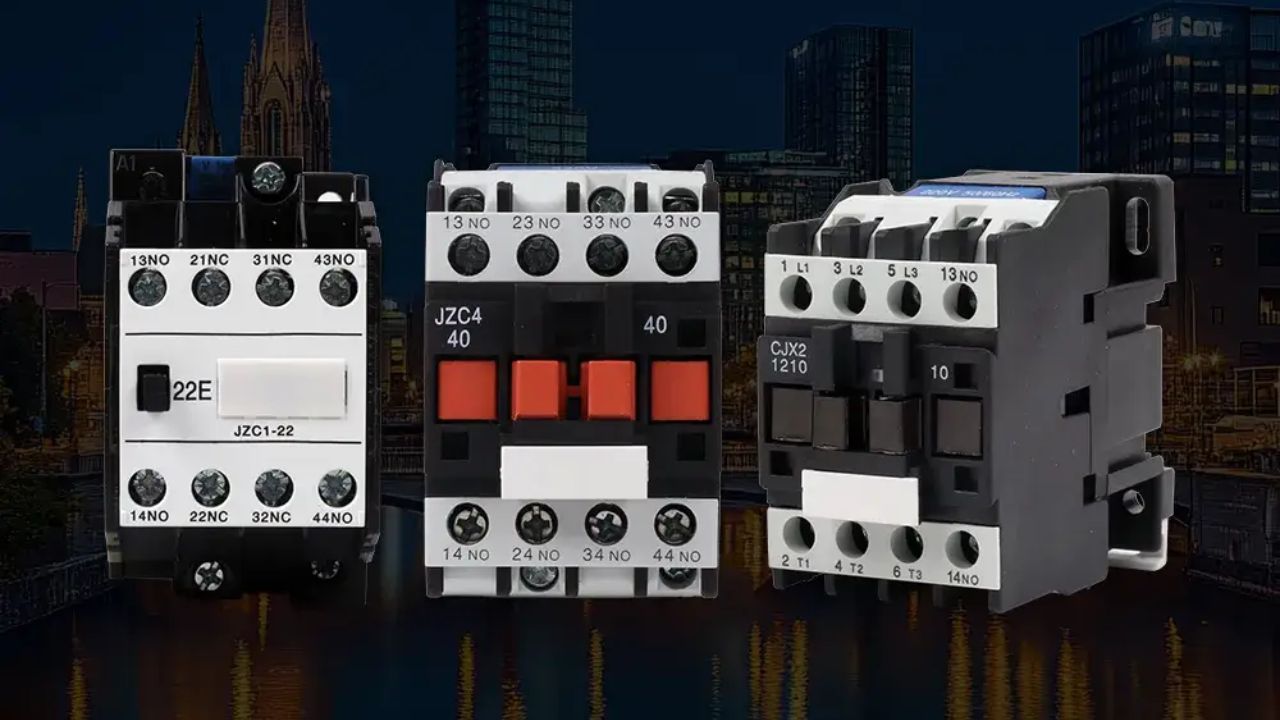
When selecting switching devices in an industrial electrical system, the choice made is critical in terms of safety, reliability, and efficiency of work. Relays and contactors are considered to be among the most widely used control components. The question is, what is the difference between relay and contactor? They are operating under very different conditions, despite both having a common fundamental purpose, i.e., to open and close electrical circuits. The improper device selection may lead to the early malfunction or even overheating of the equipment, as well as its destruction, or even a severe safety issue. The knowledge of the selection of a relay or a contactor is thus a critical aspect that the engineers, the panel designers, and the maintenance professionals need to know about the industrial setting.
Understanding the Role of Relays in Industrial Systems
A relay is mainly employed in the control of low-power circuits. It permits a small electric circuit to control a relatively large one, but not to provide electrical contact between the control and the load sides. Relays can also be used in the control panel in industrial use, where they perform logic, signal-switching, and interlocking. They are usually motivated by PLC outputs, sensors, or low-voltage control circuits.
Relays are perfectly applicable where the load current is not very high, and the switching frequency is not very high. Their small size and low cost make them very suitable for automation logic, alarm systems, and auxiliary control.
Understanding the Role of Contactors in Industrial Systems
A contactor is a special kind of switch that is used to operate high-power electrical loads. They have high-contact size, stronger construction, and sophisticated arc suppression devices enabling them to interrupt and make high-current and high-voltage circuits safely. Motors, compressors, heating systems, lighting banks, and other industrial loads are most commonly controlled using contactors.
Contactors in the industry should be able to work consistently under regular switching and severe electrical conditions. They are commonly indirectly connected to motor starters and, in combination with thermal overload relays, are often used to guard equipment against overcurrent. Contactors are also designed to resist high inrush currents and extended operating periods as opposed to relays.
Load Current and Voltage as Primary Selection Factors
Load current and voltage are the most critical parameters that should be considered when deciding on a relay or a contactor. Depending on the type of load and the model of relay, relays are usually appropriate when the load does not require more than 10 amperes. Contactors, however, can be used to deal with currents with a range of hundreds of amperes to several or even thousands of amperes.
Voltage level also matters. Whereas relays are capable of switching moderate voltages, contactors are designed for higher AC and DC voltages specific to the industrial power system. A contactor is nearly always the right choice when a three-phase power circuit or a high-voltage DC circuit needs to be considered.
Load Type and Switching Frequency Considerations
The nature of the load that is under control is one of the key factors that determine the type of device used. Inductive loads like motors, solenoids, and transformers produce large inrush currents and electrical arcs when switching. Contactors are constructed so as to accommodate these conditions safely, but relays will give up quickly under the same conditions due to contact wear or welding.
Another important factor is switching frequency. Frequent start-stop is a characteristic of the operations of industrial processes. Contactors have high mechanical and electrical durability, which ensures they are used repetitively all day long.
Safety, Reliability, and System Longevity
Contactors offer increased protection on power circuits as far as safety is concerned. They are well built, and their arc suppression equipment and compatibility with overload protection devices contribute to the minimization of electrical faults and fires. Conversely, relays are control and signaling, and not power switching, and operating them beyond their operating capacity may jeopardize system safety.
Correct device selection is also closely associated with long-term reliability. The contactor, where a relay is not appropriate, is used in order to avoid downtime, maintenance problems, and unforeseen failures. On the other hand, a relay is cost-efficient when used in low-power tasks that do not require needless costs and space consumption.
Conclusion
The decision between the selection of a relay and a contactor in industrial practice is based on a number of important considerations; these aspects are load current, level of voltage, type of load, and frequency of switching. Relays- they are most often used in low-power control and automation logic, whereas contactors- they are always used to switch high-power industrial loads in a safe and reliable way. Through knowing the functional variations and the necessity of use of each device, engineers and system designers are now able to construct electrical systems possessed of greater safety, efficiency, and enduring durability. The right decision not only saves equipment but also provides a reliable and smooth industrial operation.